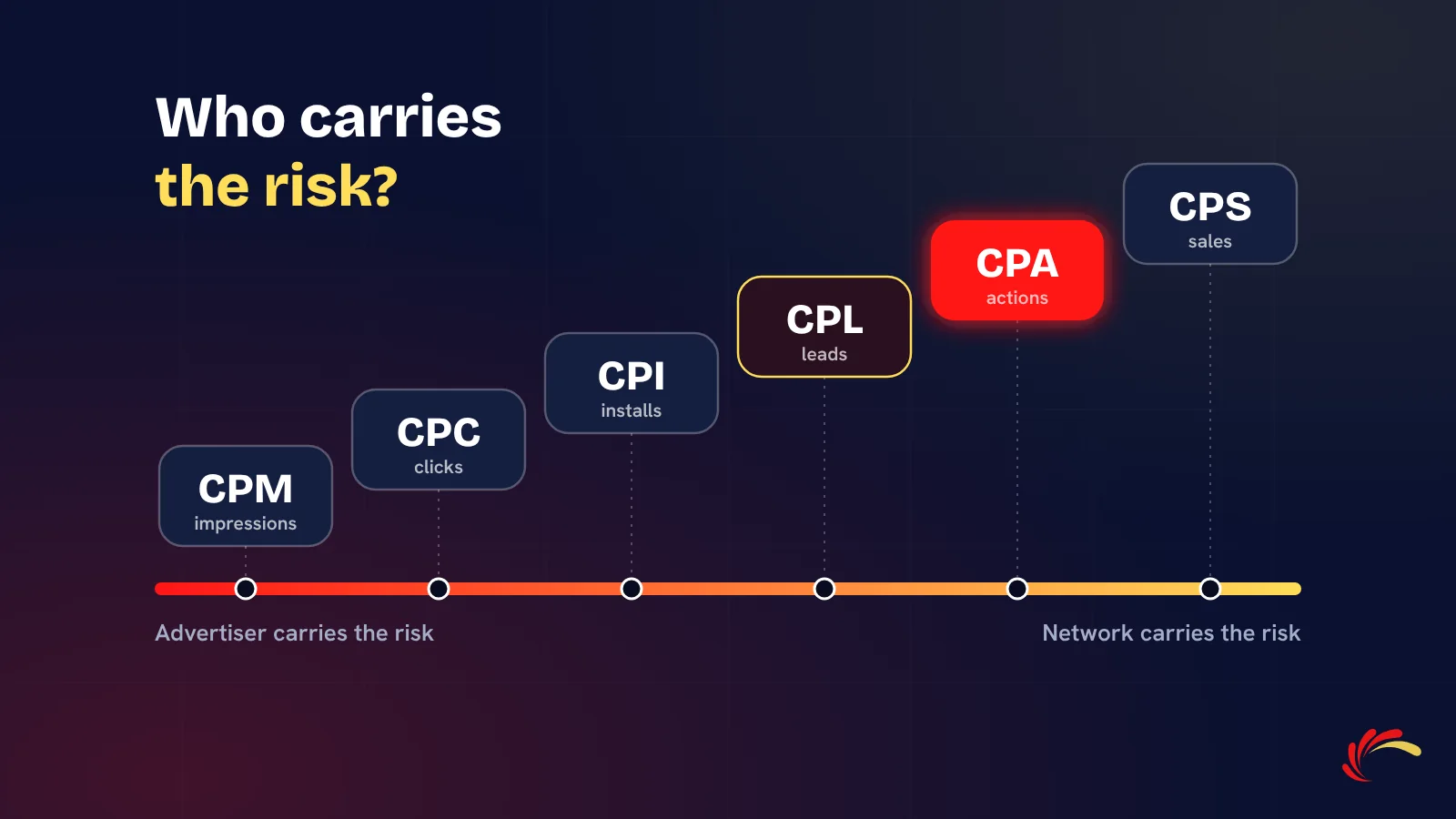
Every pricing model answers one question: who carries the risk that a user turns out to be worthless? On CPM and CPC, the advertiser does. On CPA and CPS, the network and its publishers do. Most performance campaigns sit in between, and picking the right point is the first decision in any brief.
Why the model matters
The model decides what publishers optimise for. Pay per install and you get installs, as many and as cheap as possible. Pay per first deposit and publishers start caring about who those users are. Neither is wrong; they suit different goals and different budgets.
It also decides how fast you learn. An event that happens once in a thousand installs gives publishers almost no signal, so campaigns struggle to scale. An event that happens to most users is easy to optimise but says little about value.
The models side by side
| Model | You pay for | Who carries the risk |
|---|
| CPI | An app install | Building an install base fast | First open |
| CPM | 1,000 impressions | Advertiser |
| CPC | A click | Mostly advertiser |
| CPI | An install | Shared |
| CPR | A registration | Mostly network |
| CPL | A qualified lead | Mostly network |
| CPA | An action you define | Network |
| CPS | A sale | Network |
When CPI makes sense
CPI works when installs themselves move the needle: a new app that needs ranking and reviews, a game with strong organic monetisation, or a market where you are still learning what users do. It is the easiest model to buy at volume.
The trade-off is quality. Pair CPI with KPIs such as day-1 or day-7 retention, or a minimum event rate, so publishers have a reason to care about what happens after the install.
Choosing a CPA event
The best CPA event sits close to revenue but still happens often enough to optimise toward. Good candidates:
- Fintech: KYC completed or first deposit, rather than first trade.
- Gaming: tutorial complete or level reached, rather than first purchase, when purchase rates are low.
- E-commerce: first order, with a minimum order value if needed.
- Subscriptions: trial start or first paid month.
If your ideal event is rare, consider a two-step deal: a lower payout on an earlier event plus a bonus on the deeper one.
CPL, CPR and CPS
CPL suits finance, education, real estate and automobile, where a sales team takes over after the form. Agree the qualifying fields upfront, such as city, income band or course interest, so you only pay for leads that meet them.
CPR is a lighter version for sign-up driven products, usually with OTP verification to keep it clean. CPS pays a fixed amount or a share of each sale and fits e-commerce and subscriptions where order value varies.
Working out your payout
Work backwards from what a user is worth to you. If an average user brings in ₹1,000 over the period you care about, and you are willing to spend half of that to acquire them, your ceiling is ₹500 per user. If one in five installs reaches your CPA event, that ceiling is roughly ₹100 per install on a CPI deal.
These numbers are an illustration, not a benchmark. Use your own user value and conversion rates, and leave room for testing in the first weeks.
A payout that is too low simply does not get traffic: publishers compare it with every other offer they could run. Starting slightly higher and tightening once data comes in usually reaches scale faster than the reverse.
Getting started
Send us your product, geos, the event you want to pay for and your target CPA. We will come back by email with a proposal, including the model we would recommend and why.